Thursday, August 13, 2015

The 102 families of Iga & Koga Ninja

If you are wondering the 102 families are the 49 Iga families and the 53 Koka/Koga families. Actually, there are less then 102 families, since some of the Iga & Koga families are the same, According to the Bansenshukai the Iga & Koga, translation by Anthony Cummins & Yoshie Minami The Book of the Ninja page 25; "The people of Iga & Koka had never had a shugo governor and each clan was self-governing; they constructed small castles in each estate independently and had free rein. As having no shugo or a lord. there was not a governor to oversee them. There were numerous instances of them fighting each other to take away the other's land. Therefore, their main concentration was set on battles, each morning and every evening, and their life revolved around armament and defence. They would search for a gap within each other, send shinobi to infiltrate and set fire on each other's castles, get inside information on the enemy, interfere with the enemy's plans of alliance by disinformation, carry out raids or night attacks, and conduct strategy with innumerable changes to catch the enemy of guard."

Clearly, this destroys the myth of the Iga being a republic of freedom and defines Iga & Koka as a lawless land of chaos and constant warfare. It is comparable in modern terms to living in Afghanistan or Syria, or Yugoslavia between the years 1989 to 1992. Being in the eastern Ukraine right now or for my survivalist & prepper mates the US when society breakdowns happens.

This provides a great deal of understanding into where it was created and what ninjutsu is. In fact, the translation from The Book of the Ninja goes on to say starting on page 25 and ending on page 26: "Therefore, the result was that they thought that, in order to defeat the enemy's greater forces by using a small number of people and defeating the heard and strong, it is best to use the flexible and supple, and nothing is better than the use of the shinobi to do this. Therefore, they had every samurai hone himself with the skill of the shinobi and the lower people or genin [kanji] learn in-nin or 'stealth' techniques."

A footnote on page 26 says that "...it appears that high-ranking people performed predominantly yo-nin as it required a high level of education; however, it is difficult to assess how much of each discipline the different classes learned."

In Volume Eight, titled Yo-Nin (Page 100 of Book of the Ninja) the Bansenshukai says "Shinobi no jutsu consists of yo-jutsu and in-jutsu. Yo-jutsu in to infiltrate the enemy in plain sight with elaborate plans of ingenuity, while  in-jutsu is to 'steal in,' hiding yourself from people's eyes. In this volume are written the techniques to infiltrate by inventing innumerable plans which should be ever changing according to the situation, and finding and taking advantage of any gap within the enemy while you are in plain sight - that is why it is titled yo-nin."

So we know now that Yo-nin and yo-jutsu are the same things, its just logical to assume (correctly so) that in-nin and injutsu are the same. What is of great importance is in understanding the text I've cited on a deeper level. When you hear about "high-ranking" and "low-ranking" here they are talking about social status. The genin were therefore criminals or other low-ranking people in society. So even if one was a high-ranking member of society they were required to know certain things like burglary, pick pocketing, forgery and so on.

Even when discussing "low-people" in modern society, a modern shinobi should be aware of and/or experienced with the methods of criminals and other unsavory types in "the gutter." However, yo-nin is what I wish to focus on, the to infiltrate the enemy in plain sight with elaborate plans of ingenuity. There are a list of skills and methods for doing so both within the Bansenshukai and within Black Dragon Ninjitsu. It is unknown if the Iga and Koga shinobi had different schools and traditions with a variation of ninjutsu techniques but clearly Fujibayashi who compiled the information in the first place traced ninjutsu back to one point. So we are found with a quote from Fujibayashi that he attributes to the Dialog of Tai-Zong, in which Li Ting says:
"Zhang Liang learned the Six Secret Strategic Teaching and the Three Strategies of Huang Shigong written by Jiang Ziya. Also, Han Xin learned Sima Rangju and Sun Tzu."

However, Fujibabashi goes on to state "However, it was limited to the Three Focuses and the Four Schools. One of these three focuses is about ninjutsu." on page 24 of The Book of the Ninja.

Well first off Sun Tzu (the most well know eastern strategy doctrine in the West) was not as widely available then at it is now. In fact, many people who had access to the information did not openly share it. Some of those who who had it had incomplete copies of the iconic text. Also, only when one has studied the text multiple times and in depth does one find those brief passages repeat a theme within the text. These general themes are never openly explained and are therefore considered "secret" because you have to read, study and meditate on the text to understand these themes.

But, Fujibayashi is not speaking of Sun Tzu instead his is speaking of the Chinese treatise on civil and military matters title the Six Secret Teaching by Jiang Ziya but also connects the strategic principles to Sun Tzu. The Six Secret Teachings is important because it is the only one of the seven military classics that is written from a revolutionary prospective.

The Six Secret Teachings is organized into six chapters:
  1. The Civil Strategy: Is focused on organizing the state to support military action and the importance of alliances and diplomacy. 
  2. The Military Strategy: Is a continuation of the concept of using alliances and diplomacy, as well as the focus on what we call "winning hearts and minds" today. A concept that historically allowed us to win every battle but lose the war in Vietnam.
  3. The Dragon Strategy: Is a chapter focused on core basic military matters ranging from general maintaining military moral, order and discipline, to basic tactics and use of unorthodox thinking and flexibility between commanders and leaders "on the ground."
  4. The Tiger Strategy: Focuses on tactical principles and military equipment. Tactical principles are focused around ambush and withdraw under assault, favoring speed, maneuverability and  misdirection.
  5. The Leopard Strategy: Is focused on using terrain to one's advantage, use of strategic forces and tactical thinking deployed against a stronger force by targeting strategic weaknesses.
  6. The Dog Strategy: The dog strategy contains a lot of miscellaneous material, for the other chapters on weakness to exploit within the enemy, the use of selecting soldiers for elite infantry units for special missions, training those soldiers, as well as detecting enemy moral and a warning against attacking when moral is high.
This is a huge difference in how strategy is view by Jiang Ziya and as it is presented in the Bansenshukai is that Iga and Koga. Fujibayashi's statement about clans (families) of Iga & Koka being without a Lord and so engaging in various and constant internal conflicts shows were ninjutsu moved into specifically Japanese context. These internal struggles would require an indirect method of using small teams of soldiers as opposed to sending whole armies (which would very small compared to a formal armies under shugo made up of several clans) to commit to direct battle.

The Chinese states that influenced ninjutsu were in many cases the size of Japan's main island or, larger then Japan's main island of, Honshu. So they had more resources and larger forces, they could expend the waste of man power in open war. Even then much of Chinese thought was conserving resources more so then throwing resources at the enemy recklessly. The Three Strategies of Huang Shigong are an extension of Jiang Ziya's original Six Strategies. Jiang Ziya is credited with being the first person to write a doctrine on military strategy in China, predating Sun Tzu and believed to have been studied by Sun Tzu as well... 


In the 3 Strategies of Huang Shigong, we taught that the 3 strategies are fixed to each of the three styles of government, the importance of Generals being unquestionable once they assume command & that attacks are to be swift and deceive guided by strategic goals. More so, the principles are laid out that should be mastered are;
  1. To alternate between hard and soft approaches, with a leader being both awe-inspiring and  benevolent as the situations calls for it.
  2. Act according to situation and avoid habits, patterns, similarities to other events or one's desires. Judge each situation with perception, observation and be willing to adapt. 
  3. Offers insight into others, and warns to use only the capable.

Han Xin, is a historical figure in ancient China (birth date unknown but died 196BC) who was a brilliant military leader. Sima Rangju, a powerful general and author of The Methods of Sima, another of the seven Chinese military classics.


"Zhang Liang learned the Six Secret Strategic Teaching and the Three Strategies of Huang Shigong written by Jiang Ziya. Also, Han Xin learned Sima Rangju and Sun Tzu."

When Fujibashi goes on to state "However, it was limited to the Three Focuses and the Four Schools. One of these three focuses is about ninjutsu." we are left with an unclear understanding of the Three Focuses (without studying said Chinese Military Classics), which Anthony's notes at the bottom of page 24 that explains what these three focuses are; Strategy, Troops and Resources. The matter of four schools Anthony cites as "Strategy & Tactics," "Circumstances & Developments," "Yin and Yang" and "Techniques and Craft." According to Fujibashi only one of these skills focuses on ninjutsu.

Allow me to show you were this all going...

The above graph is hopefully able to get you to understand where ninjutsu fits into the world of warfare, in the Asian mindset. The four schools, are schools of thought concerning assessing & evaluating the situation, while 3 focuses are the foundations of directing forces; strategic goals, man power and supplies. Ninjitsu is not only the methods of psychological manipulation, strategy and tactics, infiltration and disguise but it heavily tied to the study of military strategy at all levels. The 49 Iga families/clans and 53 Koka families/clans applied strategy to "Economy of Force" (to borrow a martial arts term) with a lawless land of social chaos and constant infighting.

Note: Anthony's translation said Yin & Yang and I don't know if the Bansenshukai originally said this but, assuming it does, anyone familiar with Taoist philosophy know that Yin and Yang are two halves of the Tao. The Tao is a reflection of balance and acceptance of positive and negative, give and taken, loss and gain. A manifestation of the polar opposites that presents an ebb and flow to existence.

Friday, August 7, 2015

Investigating Fujita Seiko leads to more Takamatsu conflicts with his Ninjutsu/Ninpo claims

This was brought up in a forum and I'm going to put the information right here to be saved for future reference. This whole affair started off as a debate as to whether Fujita Seiko was the Soke of all Koga Ryu Ninjutsu or just Koga Ryu Wada-ha Ninjutsu/Wada Ryu Bujutsu. Now this came about from a translation of Fujita Seiko's autobiography by Don Roley...

Anyone who knows Don Roley knows he has an agenda of trying to push the Bujinkan and the Takamatsu-den arts as the only legitimate sources of ninjutsu. Mr. Roley is also a high ranked Bujinkan member, or so he claims. Now if might come as a surprise but the portion of the translation by Don Roley I don't really have any problems with except at two minor points which have been brought by fellow "ninja-geeks". The image of origional Japanese is below...


And this is what Mr. Roley stated...
Ok, so I have been told that there are accusations against me regarding my translation of Fujita Seiko's biography. People are trying to say I am making stuff up and that Fujita never said that he was the last, etc.
Well, here is a picture of the page from his book in Japanese, along with my translation. I do tend to edit things so the story flows better without need to keep checking footnotes to understand things, but those who can read both languages can tell that the information about the history is intact.
Here is the English translation. Parts in brackets are from the prior page.
("My family founder, Wada Iga-no-kami.
Today we know of the Iga ryu and Ko)ga ryu, but these were not names used for the schools originally. The birthplaces of ninjutsu are Koga in Shiga prefecture and nearby Iga in Mie prefecture. The area is composed of sharply rising mountain ranges and in their narrow valleys are the remains of fortresses and strong points cover about 1000 meters. While trying to continue their lifestyle, they kept themselves sharp, preparing for conflict and searching out any piece of information they could on possible enemy moves. Thus, in their precarious position, they were well placed to put great importance and research into developing the skills of espionage and scouting.
And, in 1487 when the Ashikaga Shogun Yoshihiki attacked Sasaki Kourou the Iga and Koga served him a defeat so spectacular that their name and the skill they possessed became known and sought after among the various warlords in the nation and the Iga and Koga traditions were born.
In the times that followed, with the nation plunged into war the skills of the ninja became more and more into demand and the traditions extended into schools such as the Akutagawa ryu, Negoro ryu, Mafuu ryu, Ninkou ryu, Kouyou ryu, Kishu ryu and others. About 25 schools of ninjutsu came into being.
But, all these schools came from the two main sources of the Iga and Koga. And even when talking about the Iga, they themselves were composed of 49 traditions while the Koga had 53 families passing down their skills.
My family was one of those 53, and more specifically part of the 6 families of Minamiyama, also known as the six great names of Koga. From Wada Iga-no-kami 14 generations passed down. In olden days this was how important ninjutsu was, but today it has all but died out and I am the last."

Now the issues my "ninja geek" friends addressed was that
a) Mr. Roley's translation refers to 49 Iga traditions. Anyone who knows Japanese history Iga ninjutsu was traced to 49 families of kokujin or Ji-Samurai (country samurai) and Koga ninjutsu is traced back to the 53 families of Kokujin. So their arguement is that Mr. Roley is in fact suggesting/implying that the 49 families of Iga were in fact a seperate tradition  and the 53 families of Koga had only one tradition.
b) That Mr. Roley was excusing his implied difference in the tradition/family by posting the origional Japanese when he said "Ok, so I have been told that there are accusations against me regarding my translation of Fujita Seiko's biography. People are trying to say I am making stuff up and that Fujita never said that he was the last, etc."

The issue is simple, anyone who is seeking to do legitimate historical research on ninjutsu doesn't discount that Seiko Fujita said he was the last. The big debate comes over whether Fujita Seiko (proper Japanese, with the Surname first) was the last of the Wada line or all of Koga Ryu.

Now the issue rests on this matter, Fujita Seiko had no proof he was Soke of Koga Ryu Wada Ha ninjutsu. As Fujita clearly states in the translation provided by Mr. Roley, his family was one of the 53 families and his line began with Wada Iga no Kami. You'll notice first that Seiko states that "Today we know of the Iga ryu and Koga ryu, but these were not names used for the schools originally. The birthplaces of ninjutsu are Koga in Shiga prefecture and nearby Iga in Mie prefecture."

Now to any ninjutsu researcher, we understand that Fujita Seiko was explaining that Iga Ryu & Koga Ryu is a blanket term for schools arising from those areas. And many feel that Don Roley is translating the text to account for why there are multiple ninjutsu schools in the Bujinkan that would be referred to as Iga Ryu: Togakure Ryu, Gyokushin Ryu & Kumogakure Ryu. However, Koga Ryu in Japan only goes so far as Fujita Seiko's Wada Ryu.

A very in depth article on Koga Ryu Ninjutsu by the Shuto Karate Club, the article notes that there is a mention of 3 Wada schools in the Bugei Ryuha Daijiten, a listing for Koga Ryu Wada Ha on page 273, a mention of Wada Ryu on page 921 & a mention of another school called "Wada To" on page 273. Watatani Kiyoshi stated in the Bugei Ryuha Daijiten he believed Fujita Seiko was only expertise extended only to Koga Ryu Wada Ha. Meaning it is possible for other Koga Ryu Ninjutsu lines to exist...


Now as a person associated with Frank Dux and Ashida Kim, both claiming Koga Ryu lineages what I feel about Fujita Seiko being the last of the Wada line and last Soke of Wada Ryu could be seen as my own bias. But, what about Watatani Kiyoshi who has nothing invested in any such systems? More so, it is my belief as an amateur researcher & "ninja geek" that Fujita Seiko may have been the last ninja period... end of story. We all know I think Takamatsu made up his ninjutsu and when I got into researching Fujita I found some interesting facts...

1. Fujita Seiko's first book on ninjutsu in 1936, during Japan's own Ninja Boom (50 years before America's 1980s Ninja Boom) in pop-culture.


2. That Takamatsu's claims in China cannot be verified, most of his claims in Japan cannot be verified. However, Takamatsu's autobiography states on interesting things.

First, that Takamatsu wrote this brief autobiography in 1955, nearly 20 years before his death...
Second, that Takamatsu claims to have learn ninjutsu from both Ishitani and Toda Shinryuken. However, Takamatsu only lists Ishintani Matsutaro Takekage as him teaching Kuki Happo Biken no Jutsu (this is a reference to the Kuki family's art of Kukishin Happo Biken Jutsu). He attributes Toda to teaching him Koto Ryu and Togakure Ryu and Koshijutsu. With no mention of the other schools...

This is mainly irrelevant except when you look at the claim to Takamatsu learning ninjutsu from both men. Why is this important? Because Takamatsu was never known for ninjutsu in his early days. Takamatsu had a hand in creating a Japanese Martial Arts Organization known as the Minoku Seinen Botoku-kai but he was known as a master of Jujutsu & Bojutsu not Ninjutsu...


Now according to Takamatsu's Autobiography which can also be found here & here... He didn't open his private dojo: Sukisha Dojo until after he came back from China. The Biography at USDojo.com states Takamatsu spent 10 years in China & left when he was 20. So lets assume he was 29, for a man born in 1887 + 20 years... is 1907 and 10 years in China would put his return at 1917. A Genbukan site states Takamatsu returned from China in 1919 but says he started his personal school in May of 1950. Which means Takamatsu would have been 63. It is important to note that Takamatsu's ninjutsu legacy rests mostly with Masaki Hatsumi as Takamatsu was not known for ninjutsu previously... His first published article on ninjutsu was in the later 1960s and the article on Fujita cites his displeasure at Hatsumi and Takamatsu for openly teaching ninjutsu, but this was in 1967.

Now let us compare dates... Hatsumi and Takamatsu hold public demonstrations in the 1960s, I'll even offer the 1950 date. Takamatsu's first private Dojo (Sukisha Dojo) was opened in 1950 & before this he was know as a Jujutsu and Bojutsu master. His first, written article came in the later 1960s (1967 perhaps?).

The Historical Ninjutsu texts of the Bansenshukai, Ninpiden and Shoninki were translated in the later 1930s, Fujita Seiko had already written 3 books on ninjutsu by the time Takamatsu made his first appearance and already stated he was the last of the Wada line of Koga Ryu Ninjutsu.
Ninjutsu Hiroku 1939
Ninjutsu Kara Spy Sen He 1942
Saigo no Ninja 1954
Plus the entries in the Bugei Ryuha Daijiten as earily as 1963 (1st Edition)...

Fujita Seiko was ninjutsu researcher and known as the "last ninja" 11 years before Takamatsu formulated his own scrolls and claimed to have learned Ninjutsu. With the historical text being translated in the later 1920s and early 1930s, Japan's pop culture ninja boom occurring in the 1930s, Takamatsu's claim is suspect. This doesn't account for the pattern of behavior concerning his "theft" of the  Kuki families art and lineage or other claims which cannot be proven that sound very much unlikely and grandiose.

The problem with legitimately researching history, is that you have to work with the facts and not try to present facts to protect your own bias & opinion. The fact remains, no evidence of an existing ninjutsu school from history being in existence today exists. At best they are all modern creations, except where proven Koryu schools such as Tenshin Shoden Katori Shinto Ryu have it as part of their kuden (verbal teachings) usually only passed down to from Soke to Soke.

Update: 
So my addressing the information about Takamatsu I seemed to ruffled some feathers. As it turned out I was arguing with Don Roley's troll account Simon Edwards. Who (being Don Roley and Bujinkan member) was trying to declare all Koga Ryu extinct because Fujita Seiko was the last know practicer to come forward, apparently Don does not count Americans who claim Koga Ryu or Kawakami Jinichi. I was waiting on Don to make a few more argument before addressing a final trump card I had been holding.

You see there are 2 distinct points I chose to withhold both come from an older article written by Don Roley entitled: History of the Koga Ryu...
First someone letting it slip Simon Edwards is Don Roley:

Now comes the important points that reinforce my earlier statements concern the issue of Mr. Roley's translation. In Mr. Roley's article using the same material he translated from Japanese to English to argue that all Koga Ryu died off with Fujita Seiko, Don Roley explains Fujita Seiko own worlds stating that Iga & Koga Ryu were not part of a formal ryu or school like classical Koryu martial arts where.

So here Don Roley explaining that there was no formal schools of ninjutsu and that they were all associated by families. Don Roley states they would have names like Iga Ryu (family name)-ha or Koga Ryu (family name)-ha but notes these names didn't exist until after the warring states (Sengoku) period.

This brings us to my points; first there was no formal school of ninjutsu and by Mr. Roley's own statements how does the Bujinkan claim three distinct Ninjutsu Ryu; Togakure Ryu, Kumogakure Ryu & Gyokushin Ryu?

Now why does Don Roley say this, you might ask but answer is because Fujita Seiko said as much and Roley was quoting Fujita. This is reinforced by Bansenshukai who Don Roley's troll account Simon Edwards refers to as a "notebook" and I feel down plays the historical text conceal information that conflicts with his claims (but thats just). On Page 25 of the Bansenshukai translation by Athony Cummins and Yoshie Minami title The Book Of The Ninja states "The people of Iga and Koka (alternate spelling of Koga) had never had a shugo governor and each clan was self-governing; they constructed small castles in each estate independently and had free rien. As having no shugo or a lord, there was not a governor to oversee them. There were numerous instances of them fighting with each other to take away the other's land. Therefore, their main concentration was set on battles each morning and every evening, and their life revolved around armament and defence."


The second issue, is with each of 49 Iga families having a tradition and each of the 53 Koga families having a tradition, Fujita Seiko was only one line. Now I will say he never had a proven lineage, yet in the case of Mr. Kawakami he was historically correct. A big glaring issue here is not only later time in the 1960s of Takamatsu claiming a ninjutsu lineage, he also claims "ninjutsu ryu." So our second issue is the huge hole in the information Don Roley is presenting. Remember Takamatsu's own friend Watatani Kiyoshi said Takamatsu made use of modern information availabel on ninjutsu at the time.

Finally, because I will be called a liar by some concerning Don Roley's gaps in information, here is the entire article, via screen shots from the article at http://www.jigokudojo.org/koga.htm beginning with a close up of Don Roley's name as the author of this work...


Fujita Seiko was the last Soke of Koga Ryu Wada-ha Ninjutsu, he left no successor to his art. However if he was the only/last of the Koga families to practice ninjutsu or if more survived, I do not know. If his grandfather lied to him or if he himself was lying, as Mr. Roley addresses in his article, I do not know. Fujita was sometimes called a mere researcher and other times a ninja. You can believe what you like, I am merely presenting evidence for my belief that Bujinkan members readily run about internet calling out others as frauds, real and imagined because their own art is fraudulent, the pot calling the kettle black kind of thing.

What I do know is that Fujita Seiko, was a researcher and an author, an instructor at spy school and had a hand in making a partial translation of the Bansenshukai. He was Soke of Taien Ryu Jojutsu (short staff art), Shingetsu Ryu Shueikenjutsu (throwing blade art), Ichiden Ryu Toritejutsu (restraining or escaping from restraint by an attacker art) & Naban Satto Ryu Kenpo (lit. "Foreign Killing School" Kenpo) in addition to Koga Ryu Wada Ha Ninjutsu.

Seiko Fujita was also taught at the following...
  • Kokumin Seishin Bunka Kenkyusho (Cultural Institute of National Spirit)
  • Kobo Kinmu-in Joseisho
  • The Nakano Gakko/Espionage School
  • Toyama Japanese Army Academy
  • Rikugun Shikan Gakko/Military Officers Academy
  • Instructor in Police Bujutsu at the Tokyo Headquarters of Regimented Military Police
  • Educational Facilities of the Japanese Navy (existed from 1888 to 1945)
  • Adviser to Nihon Kararte-do Kai
I'm ending my updated information here. I more then doubled the length of the origional blog post.

Tuesday, August 4, 2015

The Enlightened Martial Artist...

Yesterday I was talking about some events with the BDFS with a student of mine. I mentioned John Keehan/Count Dante and how he was training and thinking in 1960s. Specifically, how Dante had students drinking and smoking in class to simulate "bar room conditions" which was all part of simulating combat conditions. My student's reply was "That is like how you were training us, in street cloths and stuff..."

You see Dante was an influence on me later on in life (my 20's) and Bruce Lee was an influence during my teens. Both heavily encouraged cross training and as a Black Dragon Fighting Society member I have the benefit of doing exactly that, we aren't a single art organization. If you ever read any of Dante's writings on the martial arts you'll know he didn't want to create a "new art" but, he did want to improve existing one's. Much of Dante's philosophy and ideas mirror those of Jeet Kune Do creator Bruce Lee. Being an influence on me, I've always tried to find better ways of training. I remember getting in trouble when I was nine years old because I had this idea to swing the heavy bag to simulate a moving opponent; my instructor just told us to line up and practice jump kicks against the heavy bag & I found a way to improve to exercise.

Some might find that arrogance but it came from a simple thought I had, as a someone on the receiving end what would be my first reaction? To move out the way. So why not learn to hit a moving target? It all seemed common sense to me. You see to understand my frame of mind you have to understand my childhood, when I three years old my dad, high on PCP tried to kill my mom. I remember bits and pieces of it. Enough to know I wanted to be strong and being a child of the 80's I had a whole mess of martial arts flicks to convince me that learning martial arts would do that for me. Also consider that my mother was a black belt in karate and started teaching my at 2 1/2- 3 years old. A large part of my child was devoted to becoming stronger. Sure I had other influences like Dukes of Hazard, MacGyver and the A-Team that showed anyone with a brain could improvise weapons tools. Which lead me to studying the Anarchist Cookbook as a teenager, which lead me to Uncle Fester (of Chemistry Porn fame). All this shows the elements that came to my understanding of creates an effective system.

You see these elements & ideas stuck with me even though I was learning martial arts, and of course Bruce Lee's philosophy (which I was first exposed to) through his movies. My mom, didn't believe in limiting yourself to one style of martial arts. Most of all, my mom didn't believe in having me to learn from "Paper Tigers" people with rank but little actual application experience. So many of my instructors were not always highly ranked but had a good bit of experience using what they knew.

How you use your art is vastly more important then what your rank is. Allow me explain, I had 2 karate instructors who were both Sandan (3 degree black belts). One was a Vietnam veteran with a habit of mixing hand-to-hand combatives in with his martial arts classes (he taught more then one art) and other an outlaw biker. I don't know if Sensei Smalls even used his art in combat in the military however, he did use it in bar brawls and back alley fights as a younger man. Sensei Massey of course was an outlaw biker & used his art in much the same environment. Their knowledge earned from experience out weighed their rank.

Now do not get me wrong, I am not glorifying violence or criminality but your experiences, even the things you draw inspiration from like TV and music, shapes who you are by influencing your judgement. Think about how you have some people in your life who always tell you how pathetic you are compared to them or your "heroes" suck compared to their "heroes." These are the people who try to influence you to fail so that they can feel superior. There are people who try to make you feel you can do anything. What influences you becomes a part of who you are, because effects your actions and thoughts. Ultimately, you have to use your art and the conditions for which you use it influence how you define you art. Definition alone does not matter...

I come from a family of criminals, I've seen things many people are totally unaware of. The world is not as clear cut, black and white as people want to believe. Some would say that the apple doesn't fall from the tree, well guess what... I've seen apple trees in the woods alone in clearings, things change. That is the one constant in life, events, people, outlooks and understandings are mutable. My mom, before I was born had seen how mobsters taught their kids, how these people not only had kids learning boxing and wrestling, karate and judo but how they were taught about business and philosophy. So my mom having seen this tried to emulate by who she found as my instructors. If I were to be a criminal, I would be a very dangerous and influential one. This is not me bragging or pumping myself up... It is me saying that I know who am because of what I have done.

You see in my experiences, which do extend across the globe to South Korea, Beijing and Japan, people are very much the same... The people who have to pull out their rank of (enter martial art here) don't have a reputation or the experience to back up their hype. Martial arts brings many benefits: enhanced fitness, self-confidence, mental focus and self-discipline. So don't think I'm bashing martial arts, even the less combat effective arts have benefits for children and adults alike. The one thing not all martial arts do is teach you to fight effectively.

Now don't think I am bashing martial arts, I am not. What I am doing to simply laying out the facts, as I see them. I kind of got off track here, but the jist of what I wanted to convey was simply that one's applications and experience defines one's art. An enlightened approach is to know yourself and your art for what it is.

Friday, July 31, 2015

Interview with Grandmaster Jay "Flying Tiger" Blanton

Note to Reader: This is an interview conducted over e-mail I wish I could have gotten more involved but do to time constraints for all this stuff  have going on I had to cut this short.


Ok today we are going to interview grandmaster Jay Blanton. Right off the bat I'd like to congratulate you on you life story becoming a movie. So to start of with I would like to begin there. 

Can you tell me about what got you into martial arts?
Hey Ron I am honored to be interviewed and thanks for your kind words. I got into the martial arts because of being bullied because of my speech problem and as a child I watch all the Bruce Lee and kung fu movies and being bullied I thought if I can do what Bruce Lee does these people will leave me along. Going through grade school I met a friend in Tae Kwon Do and he took up for me against the bullies and basically protected me against their physical abuse. He told me I need to take a martial arts class. I told my parents but we did not have the money to afford the classes at that time. So when I got into Jr. high school again a friend who was taking Tae Kwon Do and teaching it at our local community center told me i needed to get into the martial arts and it would help me against all the physical abuse I was going through. He said I only charge you $ 5.00 a month I signed up along with my other friends and the rest is history.

Having been bullied yourself, you started the BDFS Anti-Bully program what can you tell us about the program?
I started the BDFS Anti-Bullying Program to be more than just a bunch of martial arts techniques like most martial arts schools have. I wanted a unique training program not only show how to defend yourself against bullies but to educate the student and everybody what bullying is. We have a Instructor's Manual to help anybody not just martial artist to understand what bullying and how to avoid it at all possible and how to teach this to others. We also have a Student's Manuel so the students or anybody can understand and get educated on bullying it is like a school or college course it has everything in it the Instructor is teaching you. And we test the Instructor's of the BDFS Anti-Bullying Program as well so they are Certified to teach our unique program.                                          
Now in October in Chicago you are going to demonstrate an "anti-bully" kata, can you shed a bit of light on that?
We have came up with a Level 2 Instructor's BDFS Anti-Bullying Program Certification with the help from Gm Ashida Kim and Gm David Harris we are working on a "new" book and a manual for this program and Gm Harris will be helping me on a phone app and dvd and Instructor Certification in the future for the program. We will introduce this new Level 2 program in Chicago and the Kung Fu technique is called "Shen" which will address the psychological part of bullying and the technique will help everybody who is or has been bullied as well clear their minds from all the mental trauma they have suffered a unique and easy technique to learn and anybody can do it.  

You've met some very influential people in the martial arts too haven't you, so martial arts has really changed your life for the better?
Yes I have meet so many wonderful martial artist and had the pleasure of training with them not enough room here to name them all so I will mention a few Gm Richard Hedrick he guided me so much in my martial arts career with all his different styles and varies Instructors at his school, Gm Kang Rhee the Instructor of Elvis Presley, Bill "Superfoot" Wallace and he even trained with Bruce Lee and Chuck Norris, Gm Rhee name my system of martial arts "Mang Ho" which is Tiger in Korean which is the animal nickname he gave me. Since I had combined all my other styles into my system he told me that you have done like Bruce Lee you have created you own unique style. I call it a system because I continue to add to Mang Ho Ryu which I call it now.                          
Gm Donald Miskel my dear friend and brother I call him my family we talk on a regular base and Gm Ashida Kim again part of my family who has helped me so much not only re-doing my book but helping me with the BDFS Anti-Bullying Program Manuals. Gm David Harris again family who is helping me and teaching me "Shen" and other private things going on. And then Hanshi Frank Dux what can I say not enough room for what he has done for me again family. He has trained me in Dux Ryu, got my book and the BDFS Anti-Bullying Program in Mexico, presented me with the Dux Ryu Fellowship Award and allowed me in the Dux Ryu Circle Of Iron and named me Flying Tiger because of all the things in my life I overcame. And all the Dux Ryu patches on my uniform and my most honored one my Flying Tiger patch my personal patch in Dux Ryu I could go on. I now go by Gm Flying Tiger                        

Any advice for parents looking to enroll their kids in a martial arts program?
My advise to parents is to Please sign your kids up in a good martial arts program it will help them the rest of their life, check out the school and Instructor(s) before you jump into a martial arts school. Ask questions, take the free class, talk with other parents etc check out other martial arts schools in the area and ask your child how he likes the Instructor(s) and the class etc. It's the best thing you can ever do.                                  

Does religion or spirituality play a big part of your outlook?
Yes. Religion is a big part of my life being a born again Christian has helped me forgive all those people that have bullied me all my life from physical abuse, mental abuse and even into adulthood on the job. I could easily have beaten the snot out of those people and the people on the job but through all my martial arts training and my spirituality I didn't. Martial arts teaches us not to use what we have learned to hurt others or bully them but to only use it if we have to defend ourselves. I have walked away from many attacks and let it go rather than to hurt some one, which I knew I could easily do and being a Christian I have to to this as well.                                                                                                                    
So how is the Film project coming along &, thank you for taking the time out your busy schedule for this interview?
The movie is coming along Gene Michaels of Show Biz Productions is writing the screen play along with my help I will keep everybody updated on the progress I know this movie will help all understand bullying and when you bully some one it last a life time.                                                           
Thank you Ron for interviewing me it was my honor to share my thoughts with everyone God bless Gm Flying Tiger


Wednesday, July 22, 2015

Ninjutsu: An Study of History & Human Nature

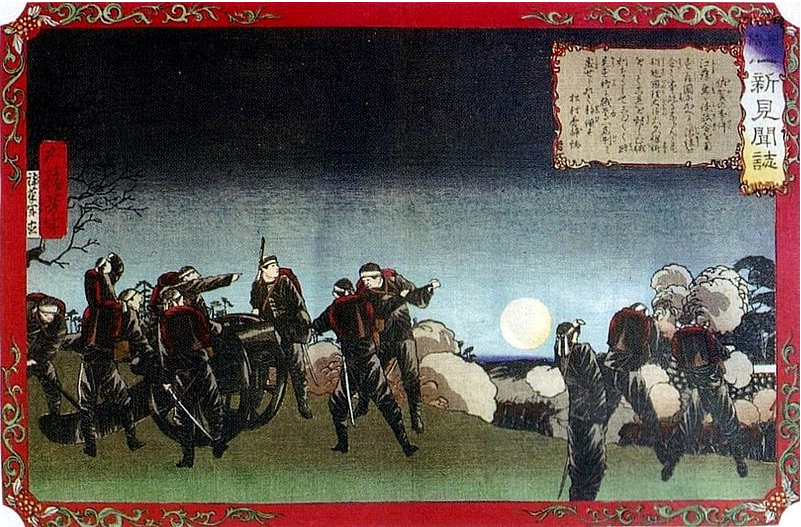
Saga Rebellion painting by Tsukioka Yoshitoshi 1839 to 1892...

It was around the beginning of the Tokugawa period also know as the Edo period when the capital was moved from Kyoto to Edo (modern day Tokyo) 1603 to 1868. The Tokugawa Shogunate/Period was founded by Tokugawa Ieyasu who was a loyal retainer of Oda Obunaga. I just remember the 3 major periods for ninjutsu & martial arts as Sengoku (Warring States Period): when most of the wars and fighting occured, Tokugawa Period (relative peace and isolationism): this is when the classes became lock and Ashigaru went from being conscripts and other classes who became part of the warrior caste to being considered low level samurai & the Meiji Restoration (marked the end of feudalism and when Japan was opened to the west).

Whats funny about the Meiji and it meant the end of the samurai class and there were numerous uprisings by Samurai against Japanese "colonialism." The Samurai of the Fukuoka Domain established a very ninja like secret society called the Koyosha, that became the Genyosha after the Satsuma Rebellion. The Koyosha worked to build secret alliances, gather information, smuggle supplies and carried out assassinations, sabotage and terrorism during the various samurai uprisings. All very ninja and carry out by former samurai. Which raises certain questions, if ninjutsu was a stand alone system why were samurai of the peaceful Tokugawa Period using "ninjutsu" skills to resist the Meiji Restoration? What if ninjutsu isn't the exclusive art of specific family schools of ninjutsu but a sub-set of skills in samurai ryu? If so many samurai ryu had ninjutsu in them, why did ninjutsu become such a lost art? Was it such a lost art if the Samurai of the Fukuoka Domain seems to have used it in the formation and operation of Koyosha? Then if ex-samurai resisted the end of their cast system using a secret society (clandestine network) and very "ninjutsu" like methods can we say the "end of the ninja" in Tokugawa Period was an end to their use and not to the study?

If ninjutsu was a sub-set of skills in various samurai ryu and not an exclusion school/style of thinking, then there never were "ninja warriors" only samurai with training in covert and clandestine operations. More so, it is possible for "ninjutsu" to have survived in some form and its seems to have done so up to the Meiji period and beyond by looking at groups like the Koyosha, Genyosha and Kokuryukai. This is an element addressed by Turnbull's article and articles various other people. Especially, looking at historical records where "shinobi" was used pretty loosely even for the Ashigaru sent on scouting missions, but little formal training in a samurai ryuha. More so, other terms were used for spies and scouts in said records then "shinobi."

So lets look at the "ninja" and use a different term, "samurai." Tokugawa's era mark the end of the warring states period, it meant samurai became more government agents then warriors. Without the need to actually use covert and clandestine tactics and strategies they became openly discussed and the modern "ninja myth" was born. Certainly, the Tokugawa Period meant that many samurai never faced combat or warfare in the later years of the period. Certainly, stories of father's exploits during the Sengoku period, became grandfather's exploits and great grandfather's exploits and eventually your ancestor "__fill in the blank__" with the passage of time. The Tokugawa period lasted 200+ years and the end of ninja's usefulness in warfare ended with the samurai's usefulness in warfare.

By comparing this to American History, the Colonial Era prior to the American Revolution produced Roger's Rangers covert skirmishers, and clandestine scouts. This was added to by various periods of Western Expansion and adding and altering the tactics and techniques of the "Ranger Docturine" disappeared between American Revolution and the Civil War. However, it should be noted Rogers Rangers fought for the Loyalists and the American Colonial Army used Roger's doctrine to create Knowlton's Ranger The Ranger's disappeared until the Civil War and only the Confederacy used said Ranger Doctrine, due to the fact that many Confederate officers were trained at West Point where they studied Roger's Ranger Doctrine and their use actually prompted the creation of only one Union Army Ranger unit: Mean's Rangers. Rangers were never used again until World War 2 and were used in the "fashion of British Commandos" however it should be noted the US Army Rangers still trace themselves to Roger's "Ranger Doctrine" which was studied and applied. Even the Alamo Scouts founded in World War 2, trace elements of their doctrine to Roger's Rangers with additions of more modern intelligence gathering & combat skills. I've read this was a direct response the operations of Japanese Nakano operatives and Kokuryukai, formed by Uchida Ryohei in 1901 who was a protege of Toyama Mitsuru a founder of the Koyosha & Genyosha and who fought in the Saga Rebellion.

Now I'm not suggesting the Kokuryukai had ninja... I am however addressing even in more modern history, principles of doctrines do not just vanish because a line of transmission of disrupted. Most Samurai Ryu existed from the Sengoku period, through the Tokugawa period where they had little usage due to that long period of peace to the Meiji Period (1868). I do not believe the Samurai just stopped studying warfare because of peace, they were the Warrior caste after all. Doctrines change with technology and situations by which they are employed. I do not believe human nature is so different just because of cultural differences. And I do not believe "ninjutsu" was a stand alone art practiced by specific schools. I believe it is a lesser skill studied by certain members of Japan's warrior caste, not only limited to the samurai but most connected to the samurai because of the status as "governors and officers" to the Shogunate. I'll let you assess your own opinions.

Friday, July 17, 2015

A Comparative Study: The Bubishi "The Bible of Karate" Translated by Patrick McCarthy & Yang Zhee Lee's Dim Mak Simplified

This was a interesting study in examining the Bubishi. First, Patrick McCarthy is a Karate Historian and his research into the "Bible of Karate" actually reveals Karate's roots in White Crane Gung-fu and among the wealth of knowledge in the Bubishi is several charts on Dim Mak. I full well plan to do a comparative study of the Bubishi & Count Dante/John Keehan's World's Deadliest Fighting Secrets, as well to see if Keehan has in fact read the Bubishi or had some access to it. I will include some questions directed to Keehan's students and those following his legacy in this matter as well. However, our focus will in fact be on Yang Zhee Lee's work for this article.


I don't need to tell you Yang Zhee Lee is a pseudonym. If fact, he explains this in the Dim Mak Simplified. The person behind the pseudonym doesn't want to tarnish his business or alternative medicine with being a martial artists and writing a book on what he considers a perversion of acupressure and acupuncture.
Now let us get to the bare bones of this examination, this is not found in the comparison of techniques between Chinese Street Fighting and White Crane Gung-fu. Nor, is it in the examination of Karate techniques but in the methodologies and vital points reference by both documents.

Let us begin with Yang Zhee Lee's simplified Dim Mak points...
Here Yang Zhee Lee breaks his target points into two specific types, points for grabbing and points for striking. More so, Yang Zhee Lee describes these vital points fall into three categories of vital points and in further description of individual points notes that some points are in more then one category of martial arts. These three categories are Dim Mak: attacking acupressure and acupuncture points to disrupt chi within the body, Dim H'sueh: which effect blood vessels and, Dim Ching: which effect nerve clusters.


Comparing it to the Bubishi we see may of the same points... though fewer used in Dim Mak Simplified. The Bubishi is of course a detailed study of martial sciences, to include herbal medicines and healing arts.

If you wish to argue that the Bubishi is merely demonstrating Kyusho or Koshijutsu, let show this & explain that even within the Bubishi is a detailed description of the Bubishi's Chinese roots, this is of course expanded for us Westerns with Patrick McCarthy's own historical investigation. And yes, the Kanji of Dim Mak & its alternative Dim Xue both of which stand for vital point manipulation.

Even in the above image you can see a reference to the time table for striking said vital points which is a powerful characteristic of Dim Mak, often separating it from similar Japanese styles. It is important to remember Okinawa is not Japan and benefited from trade and colonization with the Chinese Ming dynasty in Kume village from 1393 to Okinawas Japanese annexation of Okinawa (called the Ryukyu literally "School Boy") in 1873, following McCarthy's research. In fact, Kume was called "Okinawa's Window to Chinese culture" because Chinese immigrants brought Chinese literature, music, poetry, engineering, medicine and more. In fact, no one know who wrote the Bubishi but it appears to be Chinese in origin & a "secret" of Okinawan Karate Masters for centuries.

Those same time tables are discussed by Yang Zhee Lee using a simple set of charts, that a reader would need to reference to find the best time to strike the listed 21 Dim Mak vital points for maximum effect. In fact, the contents page explains much of the information detailed within Dim Mak Simplified.
Section 1: Details basic Gung-fu/Kung-fu beginning with the basic 5-Animal Stances: Crane, Snake, Tiger, Leopard & Dragon and their principles for application. This then addresses basic striking techniques and chin-na grappling.
Section 2: Breaks down the 5 animal short form into individual fighting tactics. Each Short for is expanded by moving from one form to the other.
Section 3: Describes training drills and exercises to build the body and develop physical power and endurance for application of Gung-fu/Kung-fu in self-defense.
Section 4: Details the charts and time tables that can be use maximize the already effective vital points of Dim Mak striking, such as; Chi Principles for understanding what chi is how it functions within the body and the universe, the five element theory of Chinese Alchemy, the Solid/Empty Organ theory of how chi circulates in the body and, finally the 12 hours of the Chinese calendar and times when chi flow is strongest to vital areas.
Section 5: Give a brief overview of Chinese Street Fighting Rules, Ranking and History.
Section 6: Deals with the Author's philosophy toward violence and how kindness is a stronger weapon then aggression. It also explains some practical first aid applications of Dim Mak.
Section 7: Is an about the author and why he chose to use a "pen name."
There is an Appendix A demonstration a 14 step Boxer's Form for additional study.

Clearly Dim Mak Simplified lacks the depth of Bubishi & few works modern or ancient truly compare the Bubishi. However, the vital points between the two works clearly overlap, though there is many more charts found within the Bubishi's texts expanding & overlapping with the 36 vital points mentioned in this article. The Bubishi is catalog of essays, philosophies, and skills ranging from simple fighting techniques to medicine and healing arts. Dim Mak Simplified is a stripped out bare bones explanation of an art without masters where one's status is obtained only by fighting others (Chinese Street Fighting) and simplification of a whole science detailed in Bubishi. Both are worth a look and both reinforce principles in the other.

The Bubishi
and
Dim Mak Simplified


Tuesday, July 14, 2015

On training with Ashida Kim & Why I left the Bujinkan...

It is sometimes a surprise that I am associated with Ashida Kim, yes some people do not know this... but, I am. I have been asked some stupid questions to try to discredit me and its honestly entertaining.  Discredit me why because I think Bujinkan Budo Taijutsu, formally Bujinkan Ninpo Taijutsu & formally Togakure Ryu Ninpo Taijutsu is a crappy martial art and the Bujinkan organization is a cult. Yet, I associate with Ashida Kim "the notorious ninja fraud" & fly the Black Dragon Fighting Society flag proudly...

To understand this you have to understand why I left the Bujinkan. Now I started in the Bujinkan 1993 and got my shodan and left the same year, my shodan had less to do with how awesome I am then Dojo politics. I love throwing the shodan, however undeserved, to tick off the Bujinkan guys. Its entertaining to watch them squirm... Prior to the Bujinkan I trained in Shotokan Karate, Goju Ryu, Judo and Sport Jujitsu. I already knew the same throws, pressure points and joint-locks and I learned Shotokan, Judo and Jujitsu in a McDojo that was a belt mill. If you know anything about Sport Jujitsu it blends Karate striking with Judo ground fighting and throws & Jujitsu standup grappling into a single sport.

So I was living in Charlotte, North Carolina when I started taking classes at a Bujinkan Dojo, why? Because I watched way too many ninja movies and wanted to be a ninja. Why is a long story but what I'm going to tell you will destroy some "sacred cows" & for now why doesn't matter. I don't remember what all I had to do at each rank but I remember being told "no sparring" until shodan (not even then really what they call Randori is a joke) and, book reports. That's right I was required to buy books and write book reports on them... History & Traditions by Hatsumi, The Grandmaster's Book of Ninja Training & one of Hayes books I can't think of the title right off, just to name a few.

Now that's not so bad but, don't ask questions... don't disagree with the "official story" and most of all don't think competition is a good thing. You basically have to accept the line "because Soke says so." Now one of the strangest things to this whole affair is that I hate the Bujinkan style of punching, and the big exaggerated stances. So I asked questions... Now I'm more then happy to say that I could take anyone there in an open competition, I even got into trouble for not using "official" techniques. But when my friends (Asians btw) heard I was training in the Bujinkan dojo they started giving me grief. I don't speak Japanese beyond Dojo and technique terms but, its funny when my friend's Japanese-American parents & grandfather are saying things like "There are no Japanese in your dojo?" I started asking questions. I always took it as a question but now that I think about maybe it was a condemning statement "There are no Japanese in your Dojo."

Now here is something to consider, there are Kung-fu schools, Tae Kwon Do schools, Karate schools and Judo and Jujitsu schools and a pretty sizable Asian population in Charlotte... you saw Japanese in Karate, Aikido and Judo schools, Koreans in Hapkido and Tae Kwon Do schools and Chinese in the various Kung-fu schools (even knew Chinese kids who learn Kung-fu under an American, not a Chinese-American but a "white guy") but we never had any Japanese in our Bujinkan dojo. In fact, it was kind of a joke with them. Now I don't doubt I got promoted to shodan to keep me in the school because when I started asking questions, others started asking questions even if our instructor didn't like it, he was easily losing creditability. So I was a shodan and got take part in Randori (Sparring)... here I was taught a lesson, that I couldn't use non-Bujinkan techniques. I couldn't punch like boxer, they have no defense for this... I couldn't use Jeet Kune Do fight strategies because (yep you guessed it) they have no defense for that... and God help me I couldn't say I thought other MAs were good. God forbid I mention other "ninjutsu instructors" from "other styles." I mentioned reading Ashida Kim's Secret of the Ninja at a public library and all I heard was only "Soke Hatsumi is the true Ninjutsu master" for about 3 days (Classes were Mon, Tues and Thursday so, those 3 days was our training week).

So lets directly address my issues and why I left...
  1. I am a Christian, the Bujinkan was the name of Hatsumi's Dojo in Japan and later became the name of whole organization. Bujinkan means Hall of the Warrior God, and you always find a Shinto shrine to Takamatsu in the Bujinkan Dojo. You bow and clap and say some Japanese gibberish, which amounts to the  “Shikin Haramitsu Daikomyo” (The Benevolent Heart; Does what is Right) & "Onegai Shimasu" which doesn't translate well into English literally but has a general meaning "I wish or I pray for good fortune in our present & future relationships." The whole of “Shikin Haramitsu Daikomyo” is in fact a Buddhist like mantra that reflects Takamatsu's teachings... So you bow to Takamatsu's image and say his mantra & offer wishes/hopes/prayers for mutual benefit. You are in essence envoking a dead man's image to provide you with good fortune. Oh and the name Bujinkan, is what Hatsumi named his Dojo, because he felt Takamatsu was a "Divine Being." Thus Hatsumi is the ninja pope... and Takamatsu is Ninja Jesus...
  2. You were completely limited to only using Bujinkan techniques... Now granted I can't "thai kick" someone in a Judo competition but, Judo doesn't claim to teach "no rules fighting" either. And you basically did "point sparring" and called it Randori, where you could only use then Togakure Ryu Ninpo Taijutsu.
  3. You can't question anything said by Takamatsu or Hatsumi even when it conflicts with things they've said. Takamatsu wrote letters to Hatsumi telling him about "spy missions" he conducted in China during WW2 & its been claimed that Takamatsu taught ninjutsu as Nakano. Ok, so a man who couldn't join the Army (Takamatsu) was sent to preform clandestine operations overseas and wrote letters to his student, that thought he was a "god" (Hatsumi) about secret mission he did as a spy? He taught at the Nakano espionage school, without any proof because the records were so super secret. I believe Morihei Ueshiba & Fujita Seiko had proof they did. HELL, I'm more inclined to believe that 007 can bang every bag guy's girlfriend, introduce himself with his real name and no one ever know who is, then I'm willing to believe a clandestine agent would write letters detailing his missions him to his little buddy back home. I'm more inclined to believe Frank Dux (take that however you want)... You must accept anything said at face value, Takamatsu says he trained in Ninjutsu for 70 years at 68 years old & didn't take lessons in ninjutsu until he was 4. You have to accept it because he was a divine being... And you have to accept Takamatsu's divinity because Hatsumi said so.
So not long after this I left, I only stayed because I kept being told about ninja secrets... I was a Shodan for a week and quit. Dishearted and disenchanted, I was already training with Reginald Martin in Omoto Ryu Ninjutsu, I didn't start calling it Black Dragon Ninjitsu until 1999. In 1999 I was awarded my Shihan, my Godan in Omoto Ryu Budo under Kioshi Omoto (who openly called his school a Jujitsu and Budo school, even if it taught ninjutsu, i.e. tactics & espionage, so yes it is the same system) and he introduced me to the Nine Shadows of the Koga Ryu but I went more with Ashida Kim's Black Dragon Fighting Society. I started training with Omoto-Sensei in 1996.

A little secret about me, I still liked the idea of "ninjas" largely thanks to the lessons of Kioshi Omoto & Reg Martin and, Ashida Kim has always taught "ninjutsu" as a separate art of strategy and never tried proclaim to be the sole source of the "truth" and he has never bashed another Martial art. Cross training with Ashida Kim was mandatory, students and BDFS members were often sent on "ninja missions" to learn about other martial arts, methods and systems. There are even Bujinkan members who train with the BDFS to learn things like strategy, espionage principles and so on but keep their way of fighting. The fact is those are fun things to play with but have little use outside of those in the professional military, law enforcement & security fields, like business and marketing fields. Ashida Kim has always separated ninjutsu from martial arts...
 Here we see Ashida Kim's Secrets of the Ninja, Right off Ashida Kim discusses Espionage Principles and using intelligence gathering as a weapon. He addresses basic meditation and kuji-kiri as basic ninjutsu & then Inpo and Tonpo. Below in Ninja Hands of Death Ashida Kim breaks his book into 3 sections, Kata Dante, Submission Holds & Ninjutsu. Huh in 1981 Ashida Kim was calling ninjutsu espionage in Secrets of the Ninja & again in 1985 in Ninja Hands of Death.
Ashida Kim was awesome, I didn't have worship his master or him. I could question him and use different techniques from systems he wasn't trained in and on occasion he'd ask the "student" to become the "teacher." If I didn't want to use Ashida Kim's martial arts, I could still train in survival skills, intelligence gathering and strategy. Oh sure Ashida Kim gets his shots taken at him and has been harassed to no end by internet tough guys and keyboard commandos. And guess what all that lineage stuff that people say makes him a fake... I never had it force down my throat by the claim to unquestionable authority.

Even in Japan, they make fun of the Bujinkan: I'm not a bullshido.net fan but the have their moments... and this was it. Thank you, Bullshido.net & random Japanese show for the laughs.
Compare it to this video of Judo Randori where the Vast Majority of students as actually Japanese (Asian at the very least). So your Dojo has so no Japanese...

If you want to waste the money buy a copy of the book; Mind of the Ninja: Exploring the Inner Power by Kirkland C. Peterson.
This book is an example of everything wrong with the Bujinkan. About half this book is bashing Ashida Kim, calling him the "Terrorist ninja." And that's not the worst part, the worst part is the last 1/3 of this book is focused on the spirituality of Shinto & the pseudo-intellectualism of calling eastern religion "superior." This book reinforces much the cult teaching I've said makes up the Bujinkan. Including a rant on how superior the Togakure Ryu Ninpo Taijutsu is to all other martial arts. The best part is it flat out denies ninjutsu as (I'm quoting the author citing Ashida Kim) as an art for "espionage, sabotage and assassination" strangely years, decades later really... Ashida Kim is proven correct by the English translations of the historical texts by Anthony Cummins. Cummins in turn is "discredited" (well accused of being discredited but not really) and inspired members of the Bujinkan, namely Don Roley, to make his own translations of the historical texts to justify the Bujinkan's stance on ninjutsu.

Now I admit, a bunch a non-Japanese teaching "ninjutsu" is suspect, but so is a cult to a dead Japanese man who told some cool stories and his disciple who thought the man was divine. I don't care if Ashida Kim said some made up BS about Atlantis; it was actually a pretty interesting point because he was comparing the legends of the Great Floor from different cultures, Atlantis to the Greeks, Noah to the Jews and Christians & the Pole Star School and Shangri-La to the Chinese. Hell I don't care if he made up his ninjutsu, its still better then being forced to Worship a dead man. Because it was an explanation that basically equates to here is some BS to brag about and sound like an idiot, because you want to talk and not train.

The Omoto family has been pretty cool about the ninjutsu thing, they wanted nothing to do with the "ninjutsu culture" and ninjutsu isn't a mainstay martial art it is a supplementary course added to their Budo; philosophy, jujutsu & weapons training. Omoto Ryu doesn't have a Soke who is head of the tradition, the highest rank award is Shihan (Master). In fact, they directed me to other schools of ninjutsu because that's what I interested in... Most people don't hear me talk about Kioshi Omoto a lot, that's because our relationship was very straight forward, learn "x" and practice "x." He wasn't a mentor or a drinking buddy and certainly not a father figure, he was a taskmaster. On the few occasions I got to ask him about things like "ninjutsu" and "lineage" his answers were short and vague. I honestly had a warmer relationship with my Drill Sergeants in Basic (and they were mentors and taskmasters, and I got to drink with them after graduation).

In my school (which I am in the process of reviving) we had boxers, karateka, hapkido practicers, BJJers, MMA wonnabes & street fighters, even a Sheriff's Deputy who studied the Bujinkan style. I didn't sit around doing Kata, non-resistant taijutsu/jujitsu drills and, talking about how our art is combat proven because our tradition is Koryu (a disputed opinion of the Bujinkan) with my students. We train... Sometimes we train in basic boxing, common for my newbies and sometimes I have guys who trained in BJJ or wrestling teach from those arts. I've had a student trained in Hapkido teach hapkido and became the "student" for that day. I've certainly done this when "Abomination" (Matt) was teaching BJJ. I'm practical, an art is only combat proven when, YOU use it in combat...

I'm also a dick, so most of my students don't want to have pictures of them with me online. Especially, those connected to the Bujinkan or the local police force. So when I seem like prick, well I am a prick but, I'm the guy who left the cult. If seem to not respect martial arts, that's cause I don't respect them out of context. When I say out of context let me explain, I don't know if Frank Dux is legit or not but Blood Sport inspired me to compete in Karate & Sport Jujitsu as a kid. When I was 15/16 year old and fought in local "street fighting" tournaments I was kid with Hollywood fantasies. I know that, I admit that but I got a black belts from belt mills, and grew up around a family of criminals. Violence was pretty common in my life and I used what knew when I needed it. Hell I even got a black belt by challenging the instructor and he wanted teach me a lesson. I learned a lesson all right, I learned martial arts are a baby sitting service for children and a fantasy camp for adults. You do it because you enjoy it and, claiming its worth based on who won what trophy or who else learned the art or claiming to have some great lineage is a sure sign of delusion. Look you can learn Navy SEAL Hand-to-Hand Combatives but that won't make you a Navy SEAL. Or to put it another way, you can train in Gracie Jiu-jitsu it won't make you a UFC champion.